

The Human Algorithm
How you can understand and learn what the bigger picture is with AI and how you can impact it.
With the innovations e.g. Steam engine, Electricity, Home Computers. We have been able to adapt and grow; with AI it is important to understand it.
Read more
We must interact with the world and know that with science as with art it can move the dial toward a caring and unique human realization, that knowledge is an answer to security and safety for our futures.
Fear has been with the human species since the beginning of time; it is only natural that we are cautious. We cannot pretend that AI will go away, it won’t. The ecosystems of the world are reacting to the population’s needs and desires it has always been this way. In a perfect world we must still be prepared to adapt.
What is AI Description
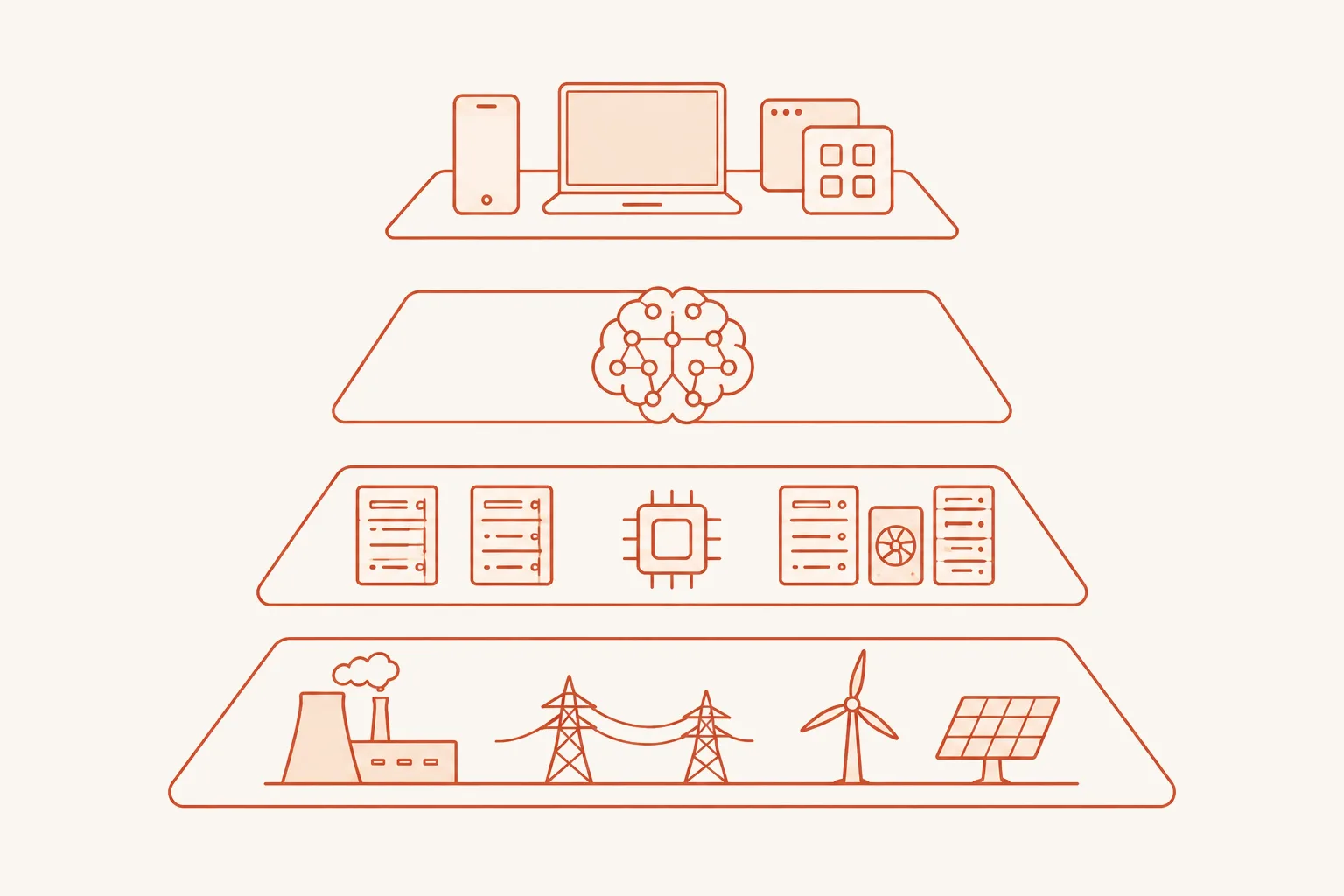
- Application
- Model
- Hardware
- Energy

AI model
An AI model is a computer program trained on a large set of data to recognize patterns and make predictions on its own.

Generative
When a computer system has the ability to create original content rather than just analyzing, sorting, or repeating existing data it becomes generative.

Agentic
When an artificial intelligence system can operate with independence, make multistep plans, and take actions to reach a specific goal without needing constant, step by step human prompts.
Open Source AI
Open Source AI refers to intelligence systems where the source code, training data, model weights, and documentation are freely available for anyone to use, modify, and distribute.
Closed Source AI
Closed Source AI is artificial intelligence whose underlying code, training data, and model architecture are kept private by the creator
Popular examples
- Open AI: GPT-4 and GPT-5
- Anthropic: Claude
- Google: Gemini
An AI model functions like a digital brain that learns from experience rather than following fixed, human rules.
-
Data Impute
Developers feed the system massive amounts of information, such as text, images, or numbers.
-
Pattern Recognition
The internal algorithms search for hidden connections and rules within the data.
-
Training and Adjusting
The system make guesses, checks its errors, and adjusts its internal settings to become more accurate over time.
Description of AGI
Accelerated Scientific Discovery
AGI could process vast amounts of cross disciplinary data to discover new drugs, formulate novel materials, solve complex mathematical theorems, and model climate solutions far faster than human researchers alone.
Healthcare Transformation
Beyond narrow diagnostic tools, AGI could personalize treatments, predict disease outbreaks, manage end to end patient care plans, and assist in complex medical procedures.
Economic Productivity & Automation
AGI could handle complex, multistep workflows such as supply chain optimization, software development and financial planning—with high autonomy and adaptability, driving massive gains in efficiency.
Personalized Education
It could act as a dynamic, highly adaptable tutor tailored to individual learning styles, helping bridge educational gaps globally.
Complex problem solving
Unlike narrow AI, AGI can generalize knowledge from one field to another, enabling it to navigate novel, unpredictable situations and assist in global crisis management.
Shift in Human Labor
By automating routine and highly technical cognitive tasks, AGI could free humans to focus on more creative, interpersonal, and fulfilling Pursuits.
Legacy of AI and AGI
Examples in history
 1 The Steam Engine
 2 Electricity
 3 Home computers
We as people have not only survived but thrived through each of these ecosystem changes. We must adapt and learn how to harness this powerful intelligence.
Understanding the Human component of AI requires some subjective thinking.
 Learning
- Reasoning
- Problem solving
 Perception
 Language understanding

Going back to the beginning the Greek philosopher’s Socrates, Plato, and Aristotle. Ethics was a description of conduct.
Socrates
Taught that virtue is a form of knowledge. He believed that no one does wrong on purpose; bad behavior comes from a lack of self-knowledge and wisdom.
Plato
Argued that a good life requires an organized soul. In his view, virtues like justice, wisdom and courage work together to keep the parts of the human mind in harmony
Aristotle
Defined ethics as practical wisdom gained through habit. He taught that virtue is the “golden mean” between cowardice and recklessness.
Ancient India
Rooted in the concept of Dharma (duty and cosmic order) Karma (the moral weight of one’s actions)
Ancient China
Confucianism focused heavily on social harmony, respect for parents/ancestors, and ritual propriety as the foundation of an ethical person
The importance of human ethical values of privacy, fairness, transparency and trust must become integral parts of AI and ML applications.
Glossary
Generative
When a computer system has the ability to create original content rather than just analyzing, sorting, or repeating existing data it becomes generative.
Agentic
When an artificial intelligence system can operate with independence, make multistep plans, and take actions to reach a specific goal without needing constant, step by step human prompts.
According to MTI Sloan this shift turns AI from a passive conversational tool into an autonomous partner capable of executing entire business processes with minimal supervision. This is different from the now familiar chatbots that field questions and solve problems, this emerging class of AI integrates with other software systems to complete tasks independently or with minimal human supervision.
Token
The smallest fundamental unit of text or data that a language model reads, processes, and generates.
Context Window
This measure’s the models memory limit (how much text it can “remember” or process at one time) in tokens.
Costs
Many AI tools and APIs charge users per token for both input you type and the output the model generates.
Processing
Models do not read raw letters or full sentences natively; they convert text into numerical IDs representing these tokens before doing any math.
